

Neopareto principle
Pareto principle states that 20% of causes produce 80% of effects. For example, 20% of customers account for 80% of the revenue, 20% of defects account for 80% of the device failures, etc. This principle is a consequence of the uneven distribution of probabilities, where 20% of the input quantity accounts for 80% of possible output values.
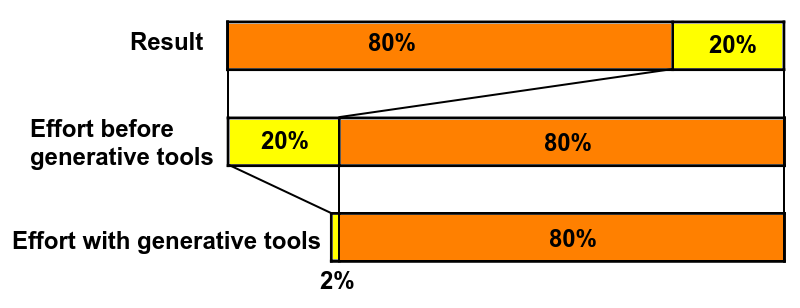
This principle also applies to the work effort (working time) in relation to obtained result. Therefore, inexperienced workers (for example, students, completing academic works) get a deceptive feeling that "the work is almost done". In fact, they have achieved 80% of the result with 20% of the work, and naively assume that the remaining 20% will be achieved just as easily. In fact, depending on the unevenness of distribution, ratio can also be 70% to 30% or 90% to 10%, etc., because the remaining 20% of the work still follows Pareto principle: 80% of the remaining 20% wor can be done with 20% of the remaining 80% of effort, and remaining 20% of 20% of work with 80% of remaining 80% of effort. If work is large and complex enough, there is a possibility that, just like Zeno's arrow never be reaches target, work may be never completed.
Neopareto principle states that, using various generative tools, 80% of result can be achieved not with 20%, but with 2% of the total work. If 20% of labor intensity decreases to 2%, then total labor intensity has decreased from 20% + 80% = 100% to 2% + 80% = 82%, or approximately only by 1/5. And even if productivity has increased not 10, but 20 or 50 times (as some techno-optimists believe), then 20% decreases to 1% or 0.1%, but total work effort does not change significantly. Company managers who do not take into account Neopareto principle are mistaken like students. Quickly achieving "almost finished" result, they believe that remaining work just small remaining part of what is already done, but in reality it is exactly the opposite.
Due to Neopareto effect, amount of low-quality digital content has increased significantly, while increase in amount of quality content (work completed to the end) has remained practically unchanged. Polish author and futurist Stanislaw Lem pointed out in his book Summa technologiae 60 years ago that development and improvement require creation of new mutations and selection (filtering). Many people say that sometimes generative tools "hallucinate". In reality todays generative tools always "hallucinate", but sometimes their "hallucinations" are also useful. If selection criteria are simple and clear (for example, rules of games), then selection can be automated and tool can improve itself. But if selection criteria are broad and complex, selection is still quite a challenge and requires manual, human made work.
Linus Torvalds rightly pointed out that writing remains writing, regardless of used tool. Attributing work to generative tool used is same as indicating that document was written by Gvim (by the way, this document was written with Gvim) or LibreOffice Writer. Those who believe that generative tools replace tool users are fatally mistaken similarly to those who fired the digger when they bought a new shovel or excavator. Modern generative tools have created a technological revolution, just as excavators and bulldozers did. But they will not make all works trivial and cheap, because, for the first time since invention of semiconductor computing, energy consumed by these tools is growing faster than their computing power.


